
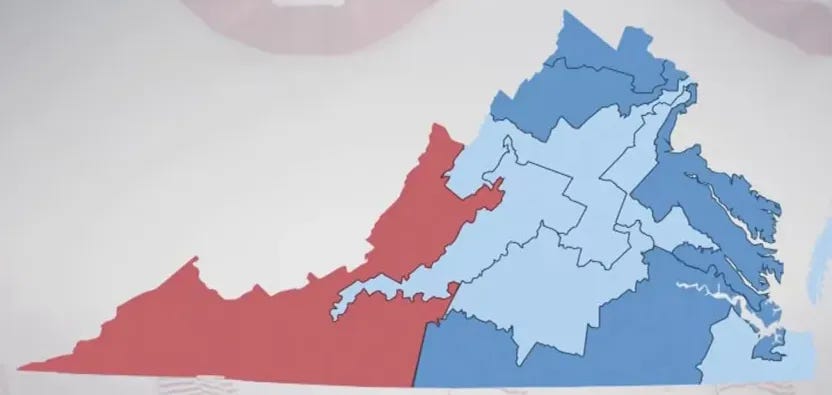
The gutting of the Voting Rights Act is a terrible thing in terms of racial justice in America, and of course it will hurt Democrats as Republicans move to take advantage of it. John Roberts’ early legal career was devoted to challenging the VRA, and the right-wing justices have been eager to role it back for a long time. It is tragic our country is taking this awful step backwards.
But one big thing the decision doesn’t change: Democrats can win the election in 2026 and the years to come by winning back the working class voters we have let slip away from us. It will force our party to build new coalitions in districts that lean Republican but suddenly have new voters from a more diverse array of racial backgrounds.
Republican leaning districts that used to be 10% Black and 5% Latino may become 20% Black and 10% Latino. The majority in these kinds of districts will still be White, but more diverse districts open up new opportunities for multi-racial working class coalitions, where the majority of voters in the district are angry at corporate abuse of power, want the wealthy to be taxed much more than they are, want serious increases in pay, and are pissed that their healthcare, housing costs, gas, and grocery prices keep rising.
The only way to win in Southern districts like this is also the only way to win in working class congressional districts throughout the Northeast, Midwest, and West: focus on winning over working and middle class folks of all races with a message focused on populist economic issues. We need an economic plan for America’s working families: stopping price gouging, capping health care costs, raising the minimum wage to $25 an hour, making it easier to organize labor unions, and breaking up corporate monopolies.
If we have an agenda like that, along with a communications and organizing strategy that reaches people where they live with voices they trust, we give ourselves a real chance to realign American politics not just for this year but for the long term.
How am I defining the working class?
Let’s be clear: the economy is not going to get any better for working folks over the next few years. Our economy is being propped up right now and is running on the AI bubble, crypto corruption, insider trading, and shaky private capital markets, all completely unregulated by the Trump administration. Very little of all this speculative financial bullshit helps working or middle class folks.
First thing to clarify: what is the difference between working and middle class? This used to be an important distinction in many voters’ minds – it was important to many people to be seen as middle vs working class. That distinction has gotten much more blurred as wages and benefits have eroded, the cost of living has risen far faster than incomes, local economies and businesses have been hit hard, and the biggest corporations have become dominant in people’s daily lives.
In focus groups, people will often say things like, “I used to think of our family as middle class but I don’t anymore. The middle class is going away,” or “I’ve always thought of us as middle class but I don’t know how I am going to afford new clothes for my kids as they go back to school.” People are identifying more with working class candidates and language. One example: when voters in a recent poll were given a list of several different ways of describing Democrats – including moderate, centrist, liberal, progressive, pro-business – the one that was the most popular by a lot was “working class Democrat.”
So how am I defining “working class”? It’s in some ways a complicated question. Many pollsters use a shorthand definition which has the advantage of simplicity, where they define voters without a college degree – which are ⅔ of the public – as the working class. However, I certainly put teachers and nurses, who have modest salaries and have to work long hard hours, as being in the working class as well. And my colleague Lauren Windsor, a generation younger than me, talks about how her generation was promised that if they graduated from college, they would be able to find good middle class jobs with a lot of security. However, for a great many of them, this hasn’t turned out to be the case at all, as people with degrees are Uber drivers or still working in low paying jobs.
It is almost easier to define working class by who is not in that category: top executives at the wealthiest corporations in the country; the financial industry traders and speculators; the partners at the biggest law, PR, accounting, and consulting firms in America, whose main clients are those corporate executives; the trust fund babies who are heirs to big fortunes.
And of course, there are plenty of people who work in professional or middle management jobs that don’t think of themselves as working class, although as AI eliminates many of those jobs, even those folks may start to identify as working class.
But most of the rest of us, the ones without huge stock portfolios and trust funds, the ones who are not masters of industry or helping the executives do what they do with their professional skills, fit somewhere in that working class description. These are the families whose working hours are usually not theirs to determine, whose income is often stretched and shaky, who feel real pain when the price of gas, utilities, groceries, or housing suddenly goes up.
They work all kinds of different jobs but share a common anxiety about their economic situation, and a sense that they have little power over their own lives. They know that an unexpected crisis – an accident, an illness in the family, a sudden unexpected spike in the cost of essential goods – could mean big trouble.
They might be gig workers or nursing home workers; people who deliver for Amazon or traditional truckers; janitors or home health aides; factory workers or farm workers; waitresses or secretaries; owners of small neighborhood businesses working 90 hours a week to keep the doors open or construction workers going from job to job. But they all work their asses off and still have don’t feel like they have the freedom to build the life for their family they dream of.
The way Democrats can win the kind of downscale voters and districts the Republicans are now winning is to root our language, our values, and the issues we are running on firmly in working class sensibilities and economics. If we succeed in doing those things, we can change American politics and stop worrying about the latest awful tactic the Republicans are going to throw at us. A coalition of economically populist working class voters, many of them from rural and factory town America, united with urban progressives and other voters appalled by MAGA”s far right authoritarian agenda, would cause a fundamental realignment in voting patterns.
Communicating with voters where they are at to build a long term majority
The media landscape has become a hellscape. If we want to build a relationship with working families,we have to start with building community, building trust, and old-fashioned neighbor to neighbor organizing. This is not done with TV ads the last couple of months before Election Day; it is done with building communities at the local level on social media, organizing house parties and community events, getting neighbors to reach out to other neighbors, and knocking on doors. We are going to have to reach out to more people than we usually reach out to, register more voters than we usually register, and talk with people in language they understand and relate to.
Democrats can become the party of working people again, just like they were when I was growing up in the post-New Geal era. We do it by organizing and communicating around an economic agenda which fights for working people and recognizes what they care about. Not only can we build that kind of Democratic Party agenda and strategy, we have to do that in order to survive as a political party. There is no other path for us to get back to winning an electoral majority.
The party with the incumbent president has lost every presidential and mid-term election in the last 20 years except one, when Obama escaped defeat by pounding Romney for what he did at Bain Capital, and what he said on the 47% tape. Voters continue to be in a “throw the bums out” mood. This means the odds are good Democrats will win in 2026 and maybe even 2028. But if all we do is not be Trump and go back to “normal”, we will get crushed in the census reapportionment election of 2030 and the 2032.
We need to have a workers party agenda that we are organizing for right now, that we build out in 2028 and in the first two years of a Democratic trifecta should we be lucky enough to have one. After the grift and naked corruption of the Trump years, we need to have a working majority for long enough to rebuild America’s economy and democracy.