
Because so much of it is dark money, we probably will never know the full amount of money the Republican billionaires threw in the fire in this election, but it was billions, and that fact is so satisfying.
These last two years have been harrowing, and we know with Trump still president there will be more harrowing yet to come. Some people gave up, walked away. But so many of us hung in there, fought through the pain, and kept organizing — as my friend Heather Booth says, with love at the center.
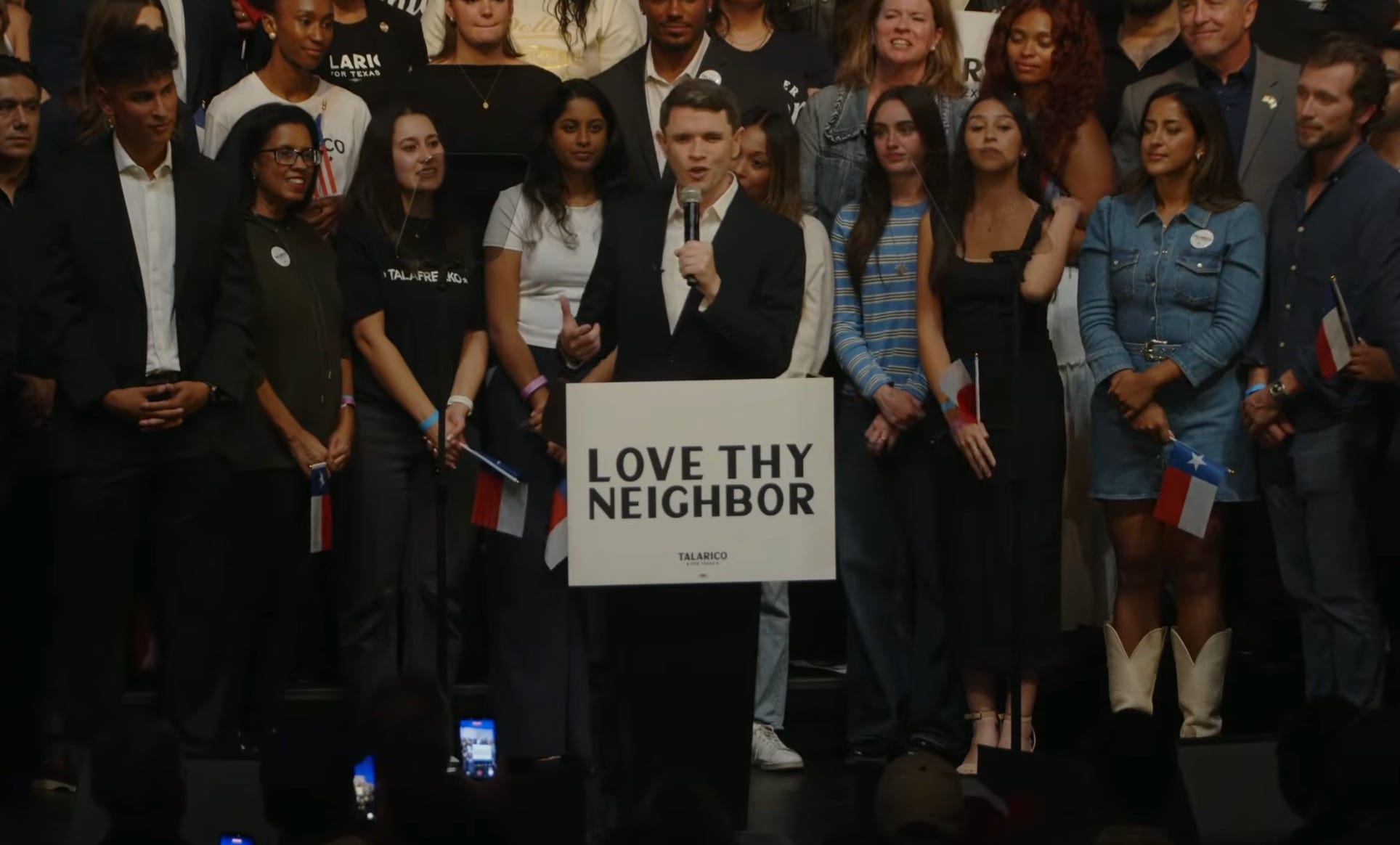
Watching James Talarico’s victory speech last night, where the podium had the sign “Love Your Neighbor,” I saw what I think is the future of the Democratic Party. Not necessarily Talarico himself, although he will be one of our party’s leaders for many years to come, but in his combination of tough, fighting, go-up-against-the-billionaires economic populism, and preaching the gospel of love for our neighbors. It is that combination of kindness and toughness that will make the Democratic Party an enduring majority party again.
Working-class Democrats
In the last century, Democrats have had only three elections as dominant as this victory:
When FDR won the massive 1932 landslide (and then built on it in winning again in 1934 and another huge landslide in 1936)
When LBJ won an overwhelming landslide against Goldwater in 1964
When Democrats had an electoral sweep in the post-Watergate election of 1974
In 2006 and 2008, we won big election victories two elections in a row, but neither of them was as big as the sweeping win we had this year.
All of those victories, this one very much included, were built on a combination of massive turnout by base Democratic voters plus surprising gains with working-class and non-urban swing voters. But what made this victory so sweet and simultaneously so tenuous in terms of the future is that most of the working-class voters we won back are still very skeptical of the Democratic Party. We did not win them back because they have regained their faith in us; we won more of their votes in this election because they felt so betrayed by Trump and the mindless following of him by Republicans in Congress.
We now have an opportunity to build on these gains with working-class and non-urban voters, but there are absolutely no guarantees. We have to show them we will fight for them, taking on the big money and corporate corruption that currently dominates DC. We can do this by passing laws people support on the economy — like raising the minimum wage, taxing the wealthy, restoring cuts in Medicaid and to health insurance subsidies, stopping price gauging, capping drug and other health care costs. If Trump wants to veto all those things that have 60%+ approval, so be it. If he signs any of them, all the better.
And let’s keep the focus on corruption. Not just Trump’s personal corruption, but the corporate corruption permeating our political system. One thing we really succeeded at in this election was tying the corruption of Republicans to the ways that costs were being jacked up for voters by their corporate contributors, and we need to keep hammering on those issues.
Important Things to Note About This Election
There are always a variety of things that stick out in an election. We will have plenty of time in the days to come to analyze more data and think about the implications, but here are things to note about yesterday’s result:
The running-as-an-Independent-in-Republican-states strategy didn’t work out. This is something I was wrong about, and I think it is important to acknowledge when you are wrong. When the idea of running populist Independent candidates sympathetic to most of the Democratic agenda in red states first surfaced in the 2024 election, I liked the idea. It seemed like these kinds of candidates not being burdened with the bad Democratic brand in Republican states made sense. I strongly supported Dan Osborn in Nebraska that year, and he came pretty close in a Republican year. This cycle, he ran again, three more Senate candidates did the same — in South Dakota, Montana, and Idaho — and a House candidate in Alaska did as well.
In a year where we were winning in tough states all over the country, none of these candidates came close. Things might be different in a different kind of year, but voters are looking for genuine people, and I think having to defend yourself against the “you’re a fake Dem” charge took its toll. I no longer think this is an idea worth pursuing. Democrats should focus on improving the Democratic brand and explaining to voters why they can be trusted, not trying to fool them by running as an Independent.Democrats need to focus more on the Catholic vote. Catholics are a very volatile chunk of the electorate, swinging wildly from election to election. They went for Trump in 2016 by 8 points, Biden by 1% in 2020, and back to Trump by 12% in 2024. This year they came back part way, but Republicans still carried them by 2 points, 50-48. This is with Latinos, who are mostly Catholic, moving far more heavily back to Democrats. That means White Catholics mostly stayed with Trump in a year where almost every other demographic group was moving strongly our way.
Bigger map, please. I hope like hell this election will finally get us over the idea of keeping the electoral map small thing that party leaders have done for far too long. Pundits have been talking about how hard it is for Democrats to win Senate races in red states, but that has mainly been because we don’t give those candidates a chance. Scott Colom in MS would be winning by more than his current 43-vote lead if national Dems had invested a little more early money in his race to get him off to a good start last year. In Arkansas, we had an incredibly talented Senate candidate, Hallie Shoffner, but national Dems never gave her a chance. In Florida, Angie Nixon almost won in spite of no investment from the national party. Especially in a year like this, where we knew early we were likely to have a great year, we should be investing some seed money in more states.
Progressive candidates were winning lots of races. The big watchword for the moderate wing of the party is electability, and generally saying over and over again that progressives can’t win their races. If they lose the primary, they often then try to prove they were right by working to sabotage the progressives who do win.
In spite of the Haley Stevens fiasco, in spite of all of the whining from all the centrist Dems about Abdul, he won by 7 points. Troy Jackson won by a solid margin against the formidable Susan Collins. Progressive House candidates opposed by the DCCC in the primary like Will Lawrence and Randy Villegas are winning their races. And as mentioned above, Angie Nixon, with so little money, almost won in Florida.
Stop the whining and stop the sabotaging. We need to be a united party, whoever wins the primary.
What next?
I will have so much more to say in the days to come, as will everyone else. Democrats have a historic opportunity to take away Trump’s power, to push back on corporate corruption, and to win big in 2028.
Democratic leadership now has big margins to work with in the House and Senate. Time to pass serious policy ideas that will either get signed by Trump and improve people’s lives, or get vetoed and show him for the corporate tool that he is. Time to get work, but let’s keep celebrating, too.