
Part of being a progressive is wanting to know about the truth of our history, being willing to acknowledge the flaws and sadness of the past and not just wrapping it all in a gauzy bubble. We know about the horrors of slavery and the destruction of 90% of the Indigenous population; we know that women and the poor did not have the vote when our country was founded or for many years after; we know working people were oppressed and nature was despoiled.
So we are deeply aware that the American Revolution was far from a perfect thing. I would argue, though, that the Declaration of Independence was one of the most important events in human history, because the rebellion it announced, and the language in it, opened the door to the possibility of a country, as Lincoln said, “conceived in liberty, and dedicated to the proposition that all men are created equal.”
Written by Jefferson, edited by Franklin and Adams, inspired in great part by Tom Paine, the Declaration stated right at the beginning:
We hold these truths to be self-evident, that all men are created equal, that they are endowed by their Creator with certain unalienable Rights, that among these are Life, Liberty and the pursuit of Happiness.--That to secure these rights, Governments are instituted among Men, deriving their just powers from the consent of the governed…
Declaring that people have the right to govern themselves, and that we are all created equal were profoundly revolutionary ideas. They were powerful and compelling enough to become the cornerstone for what Americans have strived for ever since — for every good thing that has ever happened in American history. These foundational ideas were the through line of American progress for 250 years.
The conservative movement has fought against those ideas in the Declaration from the beginning, from the American Royalists who opposed the revolutionary cause to the pro-slavery forces and Jim Crow forces in the South. A leading force in the conservative movement in the mid 1900s, Irving Kristol said, “To perceive the true purposes of the American Revolution, it is wise to ignore some of the more grandiloquent declarations of the moment.” In the mid 1800s, conservative slavery advocate John Randolph described Jefferson as the pied piper of equality and democracy, decrying the Declaration as leading to the “leveling” ideas of abolitionists in that era.
This anti-Declaration philosophy continues in the MAGA movement of our day. Senator Eric Schmitt of Missouri stated:
We were told that the entire meaning of America boiled down to a few lines in a poem on the Statue of Liberty, and five words about equality in the Declaration of Independence. Any other aspect of American identity was deemed to be illegitimate and immoral, poisoned by the evils of our ancestors.
He went on to say, in a notion repeated by JD Vance, that America is not merely a “shared set of values” or a “proposition,” but rather a homeland belonging primarily to its European settlers and their descendants.
Every progressive leader and movement in American history has claimed those ideas of government by the people and of equality among people as their own. From the abolitionists and modern civil rights leaders to the women fighting for the vote and equal rights; from the early labor union organizers to the populists organizing family farmers; from the Progressive Era reformers to the creators of the National Park system and the New Deal, the Declaration’s language and ideas have been the cornerstone of them all.
It is no accident that Lincoln at Gettysburg built the most influential speech in American history on the scaffolding of the Declaration, affirming its foundational propositions of equality and self-government:
Four score and seven years ago our fathers brought forth on this continent a new nation, conceived in liberty, and dedicated to the proposition that all men are created equal…
It is rather for us to be here dedicated to the great task remaining before us, that from these honored dead we take increased devotion to that cause for which they gave the last full measure of devotion, that we here highly resolve that these dead shall not have died in vain, that this nation, under God, shall have a new birth of freedom, and that government of the people, by the people, for the people, shall not perish from the earth.
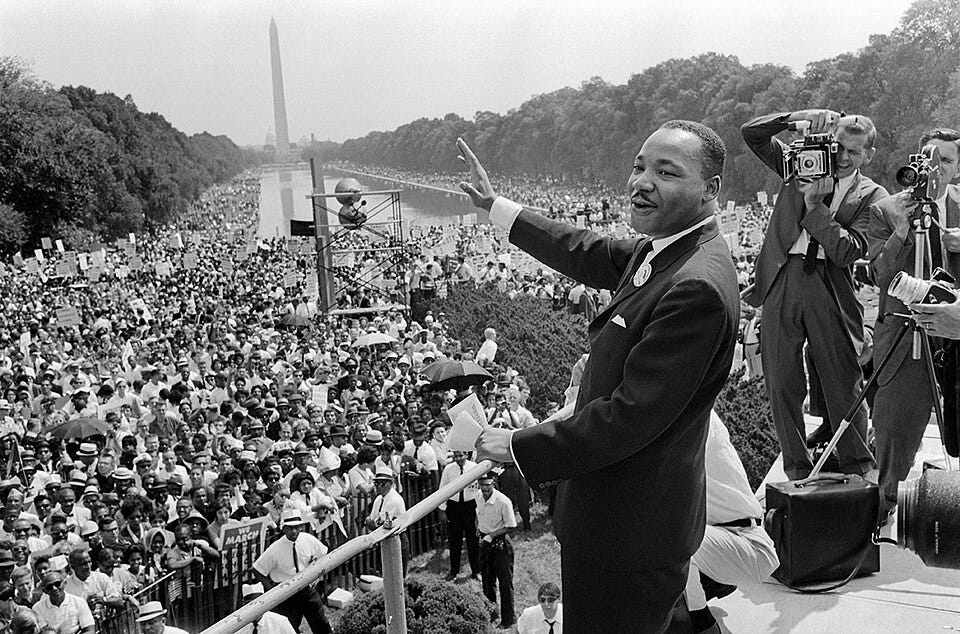
One hundred years later, Martin Luther King stood at the Lincoln Memorial, and picked up the torch:
In a sense we’ve come to our nation’s capital to cash a check. When the architects of our Republic wrote the magnificent words of the Constitution and the Declaration of Independence, they were signing a promissory note to which every American was to fall heir. This note was a promise that all men—yes, black men as well as white men—would be guaranteed the unalienable rights of life, liberty and the pursuit of happiness.
The two most important speeches in American history both referenced our most important document. All three are part of the gospel of the American ideal.
So, yes, we acknowledge that our ancestors were hypocritical men who did many wrong things. But we should take the incredible gifts they gave us, embrace our heritage, and celebrate our great nation like all get out on the 250th anniversary of its founding.
Upon getting selected to the Basketball Hall of Fame yesterday, Candace Parker said, “We are our ancestors’ wildest dreams.” We have taken our ancestors’ charge in the preamble to the Constitution, where they wanted us to create a more perfect union. In our striving to build on the foundation of the Declaration, we have indeed become our ancestors’ wildest dreams.
For our sake, and for theirs, may we find a way to overcome the fascist forces which seek to overturn the Declaration and Constitution, so that America can forge a new and deeper commitment to freedom, liberty, and the proposition that all of us are created equal.