
One of the strangest anomalies in modern political history is that the electoral coalition that elected Barack Obama to his two presidential terms was the most successful in terms of vote share since FDR – yet the Democratic Party was trounced in the 2010 and 2014 midterms, and then lost the presidential race and both houses of Congress in 2016.
The difference between those results - and the 2024 election - was the populist, working-class voters left behind.
After FDR’s four consecutive landslide victories from 1932 to 1944 (and corresponding dominance in congressional and state legislative elections), no Democratic presidential candidate had gotten over 50% of the vote twice until Obama. He also left office with a high approval rating and has stayed popular ever since. And yet, the party he led was utterly crushed in his two midterm elections while in office, and the election following his two terms — we went from having a 37-vote edge in the House and a 60-40 Democratic Senate to Republicans having both houses of Congress along with having gained over 1,000 seats in state legislative chambers around the country.
Barack Obama ran as an economic populist and got working-class votes as a result.
The difference was that the candidate Obama built a powerful three-legged electoral coalition. Everyone knows that Obama got a record turnout and percentage of Black voters, along with high percentages of Latinos and Asian-Americans; and that young progressive urbanites flocked to his campaign banner as well. But Obama also got 45% of the rural vote (tying Clinton’s 1996 performance as the highest percentage by a Democrat in the modern era), and he won the midsized Factory Towns of the industrial heartland — Pennsylvania and the Midwest. It was winning those kinds of voters that not only allowed him to carry the traditional swing states of Pennsylvania, Michigan, and Wisconsin in these elections, but also Ohio and Iowa twice, and Indiana in 2008, He almost carried Missouri in 2008 as well.
Sit for a moment with the thought of how different American politics would be if all of those states were still competitive for Democratic presidential candidates.
Obama did not govern as an economic populist, but he ran as one in both of his campaigns. In 2008 and 2012, he ran against the ultimate avatars of the political establishment, Hillary Clinton and John McCain, as the change candidate. As Wall Street was melting down, he promised to be tough on the big banks, borrowing policy ideas and rhetoric from Elizabeth Warren.
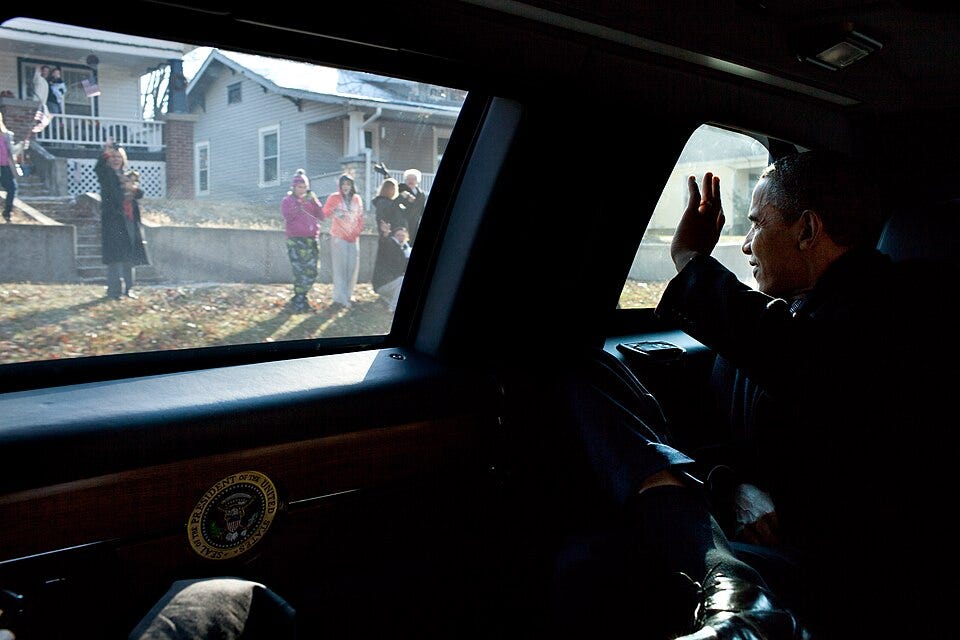
And in the 2012 campaign, President Obama gave a speech in Osawatomie, Kansas, where Teddy Roosevelt had given his famous New Nationalism speech calling for the economic reforms that would become the basis for the New Deal when his cousin Franklin took office a generation later:
I’m here in Kansas to reaffirm my deep conviction that we’re greater together than we are on our own. I believe that this country succeeds when everyone gets a fair shot, when everyone does their fair share, when everyone plays by the same rules. These aren’t Democratic values or Republican values. These aren’t 1 percent values or 99 percent values. They’re American values. And we have to reclaim them.
Obama was pitch perfect as he ran against Mitt Romney’s history as the head of Bain Capital, a hedge fund that bought up companies, stripped them of their assets, laid off their workers, and sold their spare parts like Richard Gere in Pretty Woman. When Romney’s infamous 47% tape came out, Obama’s campaign jumped on that in a populist fashion.
That economic populism convinced enough working-class rural and factory town voters that Obama was on their side to carry him to majority vote victories twice. Having a Wall Streeter like Romney as a foil also really helped in 2012. But the Obama administration’s decision to bail out Wall Street and let the bankers keep their bonuses, while forcing unions to renegotiate contracts to save the companies they worked for, was a ticking time bomb. The perception was that Obama bailed out Wall bankers, but not regular working folks.
In one exit poll I saw after the 2010 election, about 25% of voters thought the bad economy was Obama’s fault, another 25% thought it was Bush’s fault, and 44% thought it was Wall Street’s fault — and Democrats lost that segment of the electorate 2-1. The rise of Trump and far right populism in those years can be traced directly back to our lack of focus on working-class voters.
Beyond the policy dynamics, Democrats generally thought it was very cool that Obama had done so well with people of color and young voters, and were less interested in all those working-class voters he had once won. But without them, Democrats are a minority party.
Adding the populist working-class voters leg back to our coalition, and re-energizing young progressives as well
A reporter the other day asked me about what people are starting to call the Bernie-dogs (a combination of Bernie and Blue Dogs), candidates from working-class backgrounds who sound like Bernie Sanders when it comes to economic populism, but also project a more moderate image that makes working-class swing voters more comfortable voting for them. Candidates like Bob Brooks in Pennsylvania, Brian Poindexter in Ohio, Dan Osborn in Nebraska, Sam Forstag in Montana, Bill Hill in Alaska. These guys talk like normal people talk, focus on the everyday kitchen table issues voters actually give a shit about, but also have a compelling critique of how corporate abuse and concentration of power is hurting regular people’s lives.
These candidates remind me of a poll I did a while back, where we asked voters how they felt about different kinds of labels for Democrats: moderate Democrat, centrist, progressive, liberal. You know what label got the highest approval rating? Working-class Democrat.
In this era of arrogant billionaires and corporations that have built huge monopolies and interconnected oligopolies, Democrats need to show that they will fight these powers that be on behalf of everyone else.
Everyone else, by the way, is a very big number. Forbes counts 989 American billionaires; other estimates put it at around 1100. Even if you add in all the family members hoping to inherit, and all the high level execs working for them and getting great salaries and stock options; add in all the nutcases who think of Ayn Rand as their guru; add in all the Christian nationalists who want the government and their fundamentalist church to be merged, and that it is time to repeal women’s suffrage... Add up all those people, and everyone else is most of the population. We ought to be able to win a majority of voters if we show that we will fight for them and solve their problems in a common-sense way.
I hear the pushback already: what about all those businesspeople who are too moderate to want a fighting-for-the-people approach to politics? There are some of those, but I am finding more and more wealthy Democrats who are deeply concerned about how the Big Tech companies are trying to take over all aspects of American life and business. I have had three different conversations in the last few weeks with wealthy Democrats, including one of the wealthiest and most successful of the Democratic businessmen I know, who talked in ominous terms about Big Tech monopolies trying to take over everything.
The anti-monopolist tide is rising everywhere.
The formula that allows us to energize the populist Left and working-class swing voters at the same time
DC pundits who talk endlessly about the divide between the Left and the center in the Democratic Party don’t understand that the center to them is not the same as the center for voters. The DC center focuses on what makes lobbyists and donors happy, but the voters in the center of the American electorate are working-class populists who don’t like corporate lobbyists or either party’s establishment.
The reason working-class Democrats and Independents have such great appeal is that they talk in the common-sense language of regular folks about the kitchen table issues most voters care about, but also understand that corporations and billionaires gaming the system and abusing their power really pisses people off. Standing up to those who abuse their power energizes and excites young progressives and Democratic base voters, but it arguably is even more appealing to working-class drop-off and swing voters.
The signs are everywhere. Republicans are panicking at the anger over AI data centers and begging the Big Tech companies to come up with a message that saves their candidates. A poll in one race I was briefed on the other day showed that the best message in that race was one of pure anger at the utilities and their outrageous price hikes. Voters are expressing outrage at Big Oil’s windfall profits since the beginning of the Iran War. The cost of groceries is making people irate at the big food companies. People are expressing huge amounts of support for wealth taxes and closing corporate tax loopholes.
Democrats need to think more ‘bigly,’ to steal from the opposition: stop making the goal 50 plus one, while ignoring huge swaths of the country. Winning by incredibly narrow margins by eking out votes from college graduates and minorities in urban and exurban areas is not sustainable for the party in the long-term. We can start winning again in places like Ohio, Iowa, Alaska, Texas, the Rocky Mountain West, and the Plains States if we broaden our appeal to the same working families who used to vote for us at least some of the time a generation ago, before we forgot who those voters were. Those voters don’t like what they perceive the Democratic Party has become, but if the Democrats in those races express the same anger at the powers that be that voters have, our party will have a great November.
Great analysis! This should be required reading for everyone who is working on elections.